Showing posts with label teaching. Show all posts

Wednesday, February 08, 2023

I am back!!!


After four years of retirement, I am back in the classroom!  Well, not as a regular teacher but just a lecturer or should I say a workshop facilitator, for the Arts and Design program of EnzoTech Senior High School in Calatagan, Batangas.   It is so nice to be back and teaching young minds and helping them hone their craft.  The good thing about it is that I am only teaching twelve Grade 11 students. That is the current number of students in their Arts and Design strand.  Hopefully, I can help the program in attracting more students next year. I used to handle at least thirty-nine students and so it is very relaxing! The best thing about it is that these students are scholars of the Zobel Foundation so not only is their interest  in the arts solid, they have to keep their scholarship and so seeing their very good outputs make it very fulfilling! 

I owe this wonderful experience to my good friend, Henry Magahis, a former colleague at De La Salle Zobel who  is now the Principal of the school and Director of the Zobel Foundation.  I have known him since he was a fresh graduate and a new teacher at DLSZ..  I have witnessed his growth as a teacher and as an administrator.  His ascent to the proverbial “corporate ladder” was almost put on hold when he had a mild stroke last year.  I am so relieved that he has regained his health and is definitely back on his feet and doing a very good job at his current position.  I see a very bright future ahead of him.  Not only does he have what it takes to be at the helm, he seem to have unlock the formula of a good manager, but even more so, as an excellent educator.  I am truly lucky to have known him throughout the years! 

Saturday, January 11, 2014

What is true education?


This post is triggered by a friend’s fb post on Dec. 25, 2013.  In his wall, he posted a stack of books, probably his collection, and wrote:

"Is education a manifestation of the
superego qualifying and categorizing what we perceive and project ourselves to
be? Perhaps, but an educated man is not educated at all once he labels himself
and other people label him educated as well. Will a tricycle driver be more 
educated with a picture like this, a diploma in his sidecar? This is the reason
why i choose to be a teacher. Merry Christmas to all those teachers who
don't simply seek to educate"

This got me thinking.  What is education really for.  To a lot of people, education is about getting that diploma on the wall, make parents proud, and find a job and probably, get rich.  We are so proud brandishing our diplomas and sometimes even look down on others who failed to get one.  We feel smart having gone through all the preparations we made in order to get that piece of paper.  Unfortunately, there are some who, because of the high scholastic achievements feel like they are walking on cloud 9, way up there and look down on those lesser individuals who have not attained what they have achieved.  Is this what education is all about?

To be honest, education, while it does make our parents proud that we have finished college, is neither a guarantee that you'll end up having a good job nor will it make you rich.  There are a lot of college graduates who end up doing a lot differently from what they prepared for in college.  Let's face it.  We are producing more graduates than we have created jobs for them.  And each year, the number grows and grows and we have accumulated a huge number of misplaced graduates if not unemployed. 

Personally, I view education differently.   While I used to have the same notion as anybody, in my years of experience as an educator, I have finally come to the conclusion that education, in order for it to be meaningful, should be viewed as a personal enlightenment.  When we seek answers to questions during a time of wonder and awe, or maybe during times of confusion, find the answer or solution to a problem, imbibe the spirit of such information, then, we become educated. It is in the self - realization that we begin to know.  It is in finding answers ourselves that we begin to really understand. It is in finding the solutions to our problems that we find fulfillment and grasp the true meaning.  We do not need teachers to do that.  Especially teachers who think they know everything and that they are God's gifts to mankind sharing all the information they know, even if these are useless information.

Don't get me wrong.  Teachers play a very important role in the educational system.  While it is true, and I shall stand by my opinion, that education is a very personal matter.  However, sometimes, because of all the distractions we have, we tend to be lax and do not worry or marvel at the things around us.  When that happens, we do not ask questions.  We are comfortable the way we are.  And when we do not ask questions, we do not move forward.  Sometimes we do, but the problem is we may not be asking the right questions.  This is where the teachers come in.  They are the catalysts, the motivators and the guide for students to seek answers to the right questions.   Why do you think you need all those algebraic equations when you don't actually need them personally.  How many times have you used your knowledge of finding the x in linear functions in real life? The true teacher is one who makes you think.  Those equations are there for you to solve as an exercise for you to use your brains.  Think!  When you couldn't find the solution right away, they help you find it.  They find ways to make you find your way in the thickness of the forest.  It is the prime duty of the teacher to show you the connections.  This leads me to another point.  Since these are the ways in order for you to put your thinking caps on, a teacher should know how to motivate.  How could you be interested in finding the solution to a problem you do not find relevance in your life?  True, adults tell you that you will make good in life if you are good in  Math, Science and, in our case, English (because that is the medium of instruction).  How that is is probably because these are the subjects where you do a lot of thinking.  But surely, a good teacher should know how to make the subject interesting or the students will just play around if not sleep out of boredom.  The good thing is that the education system is improving.  We are starting to see the importance of showing the children the practicable use of the information we are giving them.  I did not have that luxury.  It has always been memorize, memorize during my time.

I think I digressed a bit.  My true intention of writing this post is that education is not to brag about.  We get educated because we want to know.  It is the drink that we need to quench our thirst, the food to sustain our lives.  Other than that, the knowledge we brag about is nothing.  As a matter of fact, the person who brags about his erudition is the one who needs to be treated like an idiot.  For after all, we are just humans and it is impossible for us to know everything.

"And listen to others, even the dull and the ignorant for they, too, have
their story"


Tuesday, December 10, 2013

What does it mean to teach?

Being a Fine Arts graduate with nary a course on teaching, being accepted to the academe as a teacher was never a career I ever dreamt of having.  I have always seen myself as a Graphic Designer in some acknowledged Advertising firm or a well-known painter independent of any organization without a care in the world of what my place is in a capitalistic society. However, for some reason unbeknownst to me, I ended up to be a teacher. I may attribute it to karma for I was the teachers’ nightmare when I was still a student. Nevertheless, I was asked to teach and had to accept and embrace it for that was how the dice rolled. With neither experience nor proper training, I was left with nothing but my sheer guts and with the most basic sense of logic I could muster. I plunged ahead and taught middle school Art thinking it would be a walk in the park.
 
When confronted with a task unprepared for, what one can do is to search within the deepest recesses of his/her psyche and remember the things that transpired during one’s learning years.  What did my former teachers do right and what did they do wrong?  How did I learn? How much time do I prepare and how much time to I allot for every project and concepts to be learned?  How would I know that the students have learned what they are supposed to learn?  What concepts are important for them to know?  Which among the concepts are more important?  These are some of the questions that beleaguered my then young and inexperienced self.

My first impression of teaching was that I am supposed to be the source of all information.  I am the know-it-all, come-to guy who has the answer to every query my students have, be the solution to their problems, etc.  I cannot say “I do not know” for that would only mean I am not a competent, learned man which I am supposed to be.  I should be a sage of some sort, almost a prophet to some degree.  I am way above the children for I know things they do not know and it is my duty to teach them.  After a year of surviving the classroom, I began to doubt my concept. Several years after, I confirmed it. I knew I was wrong - totally wrong missing the mark by more than a mile!

I could not be the source of all information for I do not have a brain that works like a computer.  My memory could not retain as much information as a computer can.  Even if I were the champion of some trivial game show, there are still a ton of things I will not know.  And to think the questions coming from children are far from ordinary.  Sometimes, they are not even related. Oftentimes, they ask questions coming from nowhere, you would be amazed and just wonder what this or that child was thinking in order for him/her to ask such a question.   I had to research a lot, study my lesson so that there would not be a child’s question left unanswered.  And that is only about the subject I teach.  It was then that I realized it’s alright to say “I don’t know! Maybe we can both look it up and compare notes tomorrow,” or “why don’t we make that your assignment for tomorrow?”

I thought that because I was the master of the subject I teach, I could teach it with my eyes closed.  Never have I thought that there were complexities that would arise based on the different personalities of my wards, experiences based on the social strata where the students come from, demographics, among other things.  I would have to watch my language, make sure that my words are not too complicated and have to be within their learning level.  Most of all, I learned that teaching is like acting onstage.  You have to enunciate, make yourself interesting and be understood at all times. Otherwise, I will just be a blabber of inconsequentially irrelevant information.

I had to find ways of teaching the same concepts based on the age level of my students.  And this is not only because of the fact that I had to teach the same subject to students from Grs. 1 to 12.   That was the easy part.  The harder part was to teach it to the same Grade level, of practically the same age but of different learning levels for chronological age does not equate to the same learning ability.  I should make lessons that would not be too hard for slow learners but not too boring to the more intelligent ones.  

Another impression I had was that the students should learn how to accept what I was saying, hook, line and sinker.  I was wrong.  Most of my wards are just there because they have to. Society dictated that they have to be in school.  This is where I learned about the word “motivation”.  I should make my lessons appealable to these kids.  Short of begging them to do their tasks, I had to find ways that would make them work.  A teacher could not make a student learn.  Not by force or bribery. They have to “like” it like a candy appeals to them.  A teacher needs to make learning fun and that is a relative word.  Fun is not a word that has an accurate meaning.  It changes according to age. 

Another life learning lesson I have about teaching and which is probably the best one of them all is about respect.  One cannot demand respect, it shall be given to you, if you know how to play your cards right.  One cannot impose respect from another individual even from a toddler.  One has to earn it.  Try to impose getting respect from someone, you may be able to on the surface but this is all gone when you turn your back. 

I can go on and on but I know everything will lead to only one message.  The comparison between my pre-conceived ideas about teaching is very far from my actual experience in the classroom.  No one is prepared enough.  The challenge the classroom brings is limitless and change from time to time.  I have been teaching for nearly thirty years and in all those years, I still continue to learn.  Now that I am nearing retirement, I will not be ashamed to admit that I have spent half of my years of teaching as a learning phase just to know the ropes hoping that at least, one or two in my class learned something from me. 


Wednesday, June 10, 2009

Coming full circle

When I opened this blog in May, 2004, I was just assigned to a new position in our school - that of Level Coordinator for the lower years, much like the prefect of discipline and more. The opening of the blog was very timely as new challenges laid ahead. However, much to my disappointment, I could not blog about my work, most specially the specifics as I have started to gain readers outside of my circle of friends. Hence, I blogged about education and teaching in general, which later on evolved into a gamut of different topics, a mixture of how I view life, adventures, fatherhood, family, etc.

Two years later, the school decided to do some re-organizing and I was back in the classroom again. After all, I did sign up to be a teacher. I was enjoying myself without the hassles of administrative work only mindful of grades, lesson plans and modules, etc. However, just as I was collecting more visual materials and researching for newer projects to give, a new boss appears and yet another re-organization. He invited me to his office one day last school year telling me that he was eyeing me to be the high school prefect of discipline. I respectfully declined as I do not think I still have the stamina for the position. I am but nine years away from retirement and I told him the pressures of the job might cause me my life (in full drama, hahaha). However, as a sort of compromise, I told him that if he really wanted me to be a part of his team, I was open to the idea of heading the department again, a position I handled for about nine years until I resigned in 1997. Since there was noone applying for the job from among my co-teachers, I got it. So at this time, I am now the Art Coordinator, once again taking the helm of the department. I guess this is just right as I may be too old to be teaching and about time I learned new tricks from fresher blood who speaks the language of the young and is abreast of the new trends in teaching.

So there, this blog has come full circle and awaiting new posts as new challenges await. So help me God.

Friday, May 23, 2008

Tidbits

Several days after my return from S. Korea, I was on the road again, this time with my wife and four more other couples who have been friends with us for years. We used to go out with the children a lot. They all grew up together going to places from way up north to Ilocos and Cagayan Valley to as far down south as Marinduque. However, this year, the children, theirs and ours have grown and so we all decided that we could use the break from parenting and enjoy a trip just on our own.

We took a three-day rest at Casa Ophelia owned by one of the friends' brother-in-law. It was his Taj Mahal for his wife Ophie, a resort of three swimming pools with fantastic slides, cottages and rooms. As we decided on a night trip, the ten-hour trip was bearable if it could not be called comfortable.

On arrival, we were served breakfast after we have unpacked,then took about a two to three hour nap. I decided to paint the nearby stream and the rock formations using watercolor. We all swam in the afternoon. In the evening, the guys played cards. As we were used to playing Texas Hold 'em, one of the players suggested we played Hi-Lo and we enjoyed it very much.

The following day, we went to check out the wakeboarding at Cam Sur. Unfortunately, the cables were being fixed so we failed to experience the sport. We then went to Naga City proper to check out the mall and guess what? I found a treasure! I was waiting for Nitz browsing on a small bookstore and found a thick, hardbound copy of Stephen King's "It", which sells for Php190.00. I immediately bought it thinking it will never happen again for me to find something like this.

We were joined for lunch by resort owner, Roger, who just flew in from Manila. We went shopping and then heard mass at the church where the Lady of Peñafrancia stays.

We had to leave very early the following morning as Nitz and I still have to attend my brother-in-law's wife's 60th birthday which was to be held at Antipolo. Suffice it to say that I was too tired already when we got there. But the kids had fun being with their cousins and honoring their aunt.

--------------

Now that school is about to open, the teachers are way over their heads preparing for the coming of the kids. We have to listen to different speakers during seminars, revising our syllabi, bulletin boards. This year, as I am assigned as a classroom adviser, I will have to add decorating a classroom to the list. A week more to go and we will be at the warfront once more. :-)

-----------

After a short hiatus, the blogkadahan site is running again. Spearheaded by the resident physician Doc Emer, members of Blogkadahan and invited guests will answer the Proust questions, a personality test designed by French writer Marcel Proust. Follow the llnk and see for yourselves what and how your regular blogger thinks. See you there!

-----------------

As promised, here are some pictures from my Korea trip.

Together with friends


At the dock waiting for the boat to take us to Nami Island


Chicken BBQ at Nami Island


hotel facade

at the hotel lobby

With my boss

<
The Korean connection

Monday, March 31, 2008

Revisiting the masters

Since I started this project last year which I also posted here, I saw the benefits of the project for the learners. Not only do they learn about the masters (at least some of their works), they also learn about texture and what it does for an artwork. As this is also a group work, they also learn about team work, leadership/following a leader and sorting out their differences.

While I started out with Pablo Picasso last year simply because you can segregate the colors easily, I added more artists this year. I asked the students to research about the following artists:

Foreign:

1. Pablo Picasso
2. Henri Matisse
3. Vincent van Gogh
4. Juan Gris
5. George Braque

Filipino:

1. Arturo Luz
2. H. R. Ocampo
3. Cesar Legaspi

Here are some samples of the students' work. Can you tell which painter is being reproduced?


Thursday, February 14, 2008

color harmony

One of the projects I give my students is one that teaches them to use three basic color harmonies, viz., monochromatic (use of different shades of one color), analogous (related colors), and complementary colors (colors lying opposite each other in the color wheel). What I do is let the students choose their own theme, their own medium which they are most comfortable with minimizing my control over their form of expression. Anyway, here are some of the works they produced.


Friday, December 14, 2007

Wearing different masks

There have been students of mine who would tell me that they have just read my blog. I view this as both an advantage and a disadvantage. Ut is an advantage because I believe I can explain myself better in written form, as a matter of fact, much better than when I am, say, spelling out the lesson for the day. While I do not discount the possibility that the deficiency may result from my own shortcoming to explain the lesson well, there are other factors which affect the effectivity of the presentation of the lesson. It is not just a question of efficiency for just like in a two-way communication, a lesson is presented to a recipient who may be receptive or not. The greatest factor of a lesson being not received well is partly due to the lack of interest in the receiver. This is where motivation sets in. When a teacher do not get the attention of his students and all their attention is elsewhere, the lesson is lost forever.

On the other hand, my students reading my blog is disadvantageous in the sense that it limits the parameters of what I can blog. It somehow makes me vulnerable for I usually post my thoughts, rants, and whatever strong emotions I have at the time. This is the reason why I have to restrain myself from posting anyuthing that would be detrimental to my own well-being or any matter that would refer to my place of work.

Having said that and out of the way, let me share with you an amusing story I had yesterday. There is this student who always tell me that she has just visited my blog everytime we get to talk. What was extraordinary about yesterday was her succeeding question. "Sir, how come you seem to be very nice in your blog?" I smiled and asked, "Why? Am I not nice in person?" She seem to have calculated me first, then said something like, "You're so strict and frightening everytime we are inside the classroom." Then she added, "Last year, I was very afraid of you but not anymore." Isn't that amusing?

At the risk of exposing a "trade secret" I would respond by saying that what students do not understand is that teaching is like acting in a play. It is a role I have to play, and play it well. Imagine yourself before 40 or so students at a single time, with raging hormones, learning secondary to socializing and having fun, etc. Now,you do this at least four times a day. HOw do you think should one behave? Actually, we all play different roles everytime. I am a father, a teacher, artist, VP of a teacher's union, VP of the homeowners' association, driver,etc. In all these roles, there is a different me. But in all of them, there is one unting factor. I can be a friend. I am a friend to my children, for example. But at the same time, I cannot be a friend all the time. I have to draw the line when it comes to discipline. The same thing with my role as a teacher. I can be a friend outside of the classroom but when inside, I should call the shots. Not the other way around. Reason with me, try to persuade me, but never forget that I run the show. :-)

Tuesday, June 05, 2007

To group or not to group - Part II

Once again, the question of group work has come up in a parents' orientation that the school has given yesterday. As usual, it is a question of how the kids are graded and the fairness of the grading. "What if the members are lazy and only the leader or one of the members did the work alone?"

As the question was addressed to the administration and I am no longer a part of it, I deemed it prudent not to answer the query and leave it to my superiors. After all, it was a question addressed to the whole congregation and not to me. I, too, had given group work and the question could have been thrown at me. Thank God I didn't have to answer that one for my response would not have been approved by the questioning parent. But that is getting ahead of the story.

Anyway, it is so easy to say that in the case where only one person did the work, that person should be given the full credit and flunking the others. That would have appeased a fuming parent who thinks it is unfair that his/her child is the only person who did the work. But I had been thinking about it and realized something in the process which might not be a ery popular stnce especially to parents of aspiring honor students. However, as a teacher, that is not the best response for me. Allow me to explain.

A group work is given to meet certain objectives. If the only objective was to expedite the completion of the project, then, giving the person who did all the work the grade might be okay. Afterall, the only objective is getting the work done at all costs. However, this is not the case. For me, it is more of the process than the output. The reasons why we give group work is for the students to learn team work and achieve camaraderie and a have a sense of belonging. Together with this, the students learn to decide based on their options, either by circumstance or their own creation (which plan to follow, what kind of technique or whatever to use), division of labor, delegation of duties and learn how to agree to disagree.

Based on these goals, I say, the failure of one in a group is the failure of all. They have failed to do the task because they failed to meet the objectives. It is the leader's role to assign tasks to his group, delegate responsibilities and see to it that everybody does his/her job. It is the role of the members to contribute, cooperate and respond to the leader's orders.

Come checking time, it is imperative for the teacher to see what transpired during the creation process. I talk to the entire group and question them. First the leader to find out if everybody contributed. This is not as hard in my case as most of the works have been done inside the classroom. This I do, sometimes, alone with the leader to assess if he/she is telling the truth. It may be that the leader either is covering up for the members or that he/she is intimidated into submitting the truth. Next, I talk to the members and assess how the work was done. By questioning them, I tend to feel how honest they have been and if my gut feeling tells me there's something awry, I probe in deeper until I am satisfied I get the entire picture.

So, what grade do I give in case only one person worked on the project? It depends on the outcome. If the work is good, the person who worked gets the highest grade in the group and give the others a passing mark. However, they do not get the highest mark possible and I make sure that they understand why such grade was what they deserved.

I am aware that this is not foolproof, though. Hence, at best, I do not give a very high per centage on group work vis a vis individual work. Nevertheless, I have to give them the experience of working together.

Monday, April 09, 2007

Recreating Pablo Picasso


For the final project of the Freshmen, I have decided to introduce my students to one, if not the greatest painters of all time, Pablo Picasso. This is the first time I gave this project thinking that if it will be successful, I'll incorporate other great painters, including Filipinos, next year. My purpose for the project is to show that:

1. great paintings do not always have to be are mirror images of (kamukhang kamukha) objects;
2. painting is thinking. If they read what cubism is, how it came to be and how it is done, like I told them to. (I have yet to create a module for this one).
3. That there is no truth to the saying that "even a child can do this" sort of thing.
4. That there are rules to follow even in modern art, viz., volume, harmony, balance, etc.

First, I let them look for pictures of Picasso paintings, read its history, life, etc. Then, on an illustration board, draw the picture using grids. Instead of using colors, I asked them to substitute the colors with different materials like threads, buttons, sequins, rice, seeds or whatever they can find that matches the color of the original and voila! A textured Picasso painting. Here are more samples.


Monday, December 04, 2006

A little thought

For those who do not know yet, I am an Art teacher in one of the schools in Metro Manila. I have been an Art teacher for 21 years, the same number of years I have been married. Not that that is relevant but just to give you an idea of how old I am. Teaching has never been my intended vocation, though. I am a Fine Arts graduate with an Advertising major but never got to practice this trade. I worked as soon as I graduated. Meaning I took whatever was available.

Anyway, not having been trained to be a teacher, I labored each day during my first years of teaching. I had to learn the tricks of the trade, sometimes, painfully. I had to learn to deal with each problem that came my way. Slowly, I learned what works and what does not work with my lessons. I kept those lessons that many were able to grasp, threw away those that were too hard to comprehend. Always a hit or miss with my lessons, I tried to come up with a cohesive syllabus, a word which meaning II did not have a full grasp of at the time I started.

Anyway, I have been thinking about showing examples to students. First and foremost, examples that we show the students should always be what we, in the academic world as "authentic material". By this we mean those that are seen in print and has been available to the public. Hence, if say for example that a teacher, who writes poems, should want to show a poem as an example, it should only be those that have been published and not a personal poem, he/she has written. Of course, with subjects like Science, authentic material would be an actual leaf, or whatever material is being discussed rather than showing a picture or a drawing.

At any rate, will showing examples in art, like painting styles, be beneficial to the learner. My theory is that sometimes, they are not. While it is true that examples facilitate in the understanding of a concept being taught and at best, trigger an idea for the day's project, I have the feeling that sometimes, they stand in the way for new creative ideas to prosper.

Showing examples may limit the avenue for the creation of a new style or concept since the learner has fixed his/her standard of beauty based on the example. Hence, the learner might not try to explore new avenues to attack the problem/project on hand. And yet, we must remember that the great artists, especially during the modern era, became what they are in the Art world simply because they did not go with the flow. They rebelled with what was considered as the norm. Remember, too, that art is the pursuit of beauty, which is relative in the first place. This line of thinking, again, posed a big problem for me during my first years of teaching. What if a student submits a mere line on the premise that this is his ideal of beauty? Would you have considered this as creative seeing that he/she diverted from the norm or is this a product of sheer laziness? It took me a while to learn how to parry a retort like this one. First, I should know how a student works in class. Secondly, know how his/her mind works. And lastly, come up with projects that has less subjectivity in it.

Tuesday, November 21, 2006

TV commercials

I have to admit that I am a couch potato. When I am not on the computer, there's a big chance (say about 90%) that I am in front of the television set. Like most men, you will find me with the remote on my hand, frequently changing channels trying to find a show that would suit my fancy. Well, my favorites lately has been the cooking shows like the Naked Chef, The Surreal Gourmet, Keith Floyd and Surfing the Menu (not good for my appetite). For game shows, I watch the long time running Wheel of Fortune and Double Jeopardy. I also frequent The Animal Planet and the Discovery Channel. The other 10% would be reading a book or playing the guitar.

Anyway, this post is not really about what shows I watch but the commercials we see on the boob tube. Before I proceed, allow me to reminisce first. During the mid 80's, there was this commercial with Mr. Jim Paredes saying, "These look like oranges... (bounces the orange) but they don't!" Anybody reading this remember that one? Well, if we really analyse the sentence, we will see how ridiculous the statement was. They look like oranges but they don't look like they are. Clearly, what he should have said was "but they're not!"

Anyway, the reason I suddenly remembered that ad is because there is one commercial that piqued my interest today. I have seen it several times in the local channels and I am bothered by it. I am talking about this commercial about a fifty something mother who says: "You are not my baby no more!" I checked my kids and asked, "analyse that statement and tell me, is he still a baby of hers or no more?" My children's initial reaction wass that he is no longer her baby.

Maybe we often hear this phrase quite too often in movies that we believe that this is proper english. But it's not! Well, at least the last time I looked, a double negative means it is positive! So, if we analyse the sentence carefully, it really means he is still her baby. But we know this is not the case if we look at the context by how and under what circumstances the utterance has been made.

The media's role in shaping the young is unprecedented. Schools are facing a losing battle with the media. Considering the cost of production and the coverage of these commercials, the advertisers ought to be very careful with what they show on tv and other medium.

Monday, October 17, 2005

All my own!

What is plagiarism? Ajay, who writes for the Manila Bulletin's Technorama (I couldn't establish the link at this time, sorry) section featured the Blogkadahan members about their take on the issue which appeared on Sept. 25 issue. Here, the blogkadahan members were one in defining the word, albeit said differently, and condemn the practice as it is very unproductive.

Anyway, one of the greatest sins a student can do during his lifetime is to plagiarize. Plagiarizing is the act of passing somebody else's work as your own. This can be in the form of copying actual words or ideas. Merely paraphrasing the sentences is a form of plagiarism. In this day and age of computers, to plagiarise is so tempting. Why not? All you have to do is "copy and paste"! How many high school students have done that? I guess a lot. But that doesn't make it right. Plagiarism is a crime which teachers should be conscious about in checking what the students submit to them.

Sometimes, students miss the point. What is important with research work is not only the substance you learn from the information gathered but more importantly, the learning of the process. Data gathering is an art in itself. One has to gather enough materials so as to be able to form a substantial conclusion. i don't know how teachers give the assignment but if I remember correctly, my teachers used to say, "Okay, make a research on the life of Jose Rizal... Compare and contrast his life with that of Andres Bonifacio... and then those powerful, USE YOUR OWN WORDS."

Honestyly, at the time, I didn't exactly know what that meant. I have heard those words quite often that it kind of lost its meaning. Since there are high school students reading this (I hope) I'll try to do it using a metaphor. In making your research, picture yourself as having seen a film and narrating the entire story to a friend. Now, I'm sure all of us have done that, right? You see a movie that you really liked, you tell your best friend how you liked the film. You are ecstatic. First you tell him/her a summary of what happened in the story. How the protagonist was beaten up at the start and how good triumphs over evil in the end. Then, you realize your friend does not yet share your enthusiasm, so you give comparisons like, "Yes, it's better than Harry Potter I and give reasons why you think so!" Then, if you have more time and you have a good listener, you go on deeper. You analyse the film. you talk about the persuasions of the characers - "IN YOUR OWN WORDS"

Well, in making your research, the books that you read would be the film. You synthesize these, compare the points where the authors agree and take note if there are conflicting accounts, make up your mind and write about what you think it is all about. Should you need to copy a phrase, do not forget to cite the source. You could either use footnoting or incorporate it in the text. ex. George Bernard Shaw (1956:p. 10) said: "I dream of things not here today and wonder why." (note, the year and page is bogus)

Remember, education is not really all about Math or Science or whatever subject there is. More than anything, it is about teaching you how to think! In like manner, research is not only about learning the content, what is more important is learning how to do it. hope that helped.

Friday, September 30, 2005

School sanctions

This is one post I didn't want to post but I have read somewhere that if one wants to become a writer, one should be honest if one wants to be effective in this field. Just look at the very famous writers. They were sincere with their writings and they shared what was to be shared. Now, I do not have any intentions of becoming a famous writer, but since I am doing this journal of some sorts for my children, and their children's children, I might as well do it right.

I did not want to post this because it involves my youngest son. You see, I had to suspend him for two days for a misdemeanor that he did in school. He was caught by his math teacher talking to a seatmate while a test was going on. Our handbook clearly states that talking during in a test shall be misconstrued as cheating. So, as soon as the violation report was given to me, I signed it and implemented it according to the handbook. I have told my children before I accepted this position that once they have been complained of any ill-doing, there won't be any investigation anymore but has to be addressed and be giving its full sanction. Tough job but I have to do it.

This leads me to another point. A teacher came to me once to say that a student has copied another student's assignment. The teacher was in a dilemma as to what offense has been committed. Should it be cheating? The handbook says cheating is committed during an exam. Should it be plagiarism? No, because it was not a project or a research paper the student was claiming as his own. It was an assignment. You see, assignments are done at home and the child can seek help anywhere it can be had. For me, an assignment's purpose is to aid the understanding of a lesson. Whether it be as a prelude to the lesson so that the following day, the student would have an idea of what is going to be tackled in class or it could be a review of some sorts or an exercise that was supposedly learned in class. At any rate, it is not similar to a test which aims to evaluate one's understanding of a particular lesson.

Sometimes, I do not go for the traditional way of thinking. As eccentric as it may sound, I sometimes go for different ways to handle a specific problem. It is not uncommon for me to get into trouble, mind you. But that's who I am. Anyway, considering the circumstances, I told the teacher that if it was I who was in that predicament, what I would do was to call the parent just to inform that such a thing happened, give the child a zero for the assignment and give him a similar homework (which was not to be graded anymore) if only to make him understand the concept being taught by that particular assignment. Probably a harder one since I would be working on the premise that the lesson to be learned has indeed been learned already. To my mind, this is a better sanction than issuing a violation and following the traditional sanctions prescribed by the handbook. After all, the end product should be a lesson learned from the endeavor.

Unfortunately, the teacher followed a different route. Oh well, it was by the book, so no problem. What would you have done? Was my idea so far-fetched?

Monday, September 05, 2005

Composition at work

Here's the last entry on my Art lesson posts. If you remember the things I discussed earlier, (formal and informal balance) here are two examples of how these work. I shall be using a poster as the example as the same priciples apply to practically everything else.

So, imagine that we are to do a poster of a product, say a pencil. What are the key elements that we can put on the poster? First we have a "title". Let us use the name of the product for the title. I shall use the name of my daughter, Keshia, as the product name. Then, we have a "sub-title". Usually, this is a slogan or a by-line to call the attention of the viewer. Then, there's the "illustration". Now, this is very important. You have to come up with a very catchy illustration or photograph so that passers-by would be drawn into the poster and stay awhile to look and get him/her to read the information. Next is the text or copy which is the actual information or message you want to get across. This part is usually supplied by the copywriter. When I was in college, we use to represent this with plain lines just so the printer would know where to put the text. Remember not to put very long sentences or paragraphs when the poster. Nobody will read very lengthy advertisements. Lastly, we have the company name or the logo.

Now that we know the parts, here are two examples. I used formal balance for the first example.

formal Posted by Picasa


Notice that all elements are justified. Remember that formal balance is having symmetry of all the elements. What you find at the left, you will find at the other side. In computer lingo, it is "justified". This is a very safe ploy. You will never go wrong when you use this. The only thing you have to worry about is proper spacing and proportion. (Okay, I committed a boo boo here. Notice the flap? There is something wrong with it. Can you tell me what it is?) O di ba, may test pa. hehe

Now, compare the same elements using informal balance.

informal balance Posted by Picasa


If you were the artistic director, what would you have chosen, if ever? Or would you rather that the artist create another one? Do you have another idea for a layout? Tell me about it.

I hope I was able to help someone out there with these simple tips on how to prepare a visual presentation.

Tuesday, August 23, 2005

Composition

Layout

Once again, I have been successful in coercing (in a loving way, of course) my son, Mickey to help me create simple drawings based on my instructions to share some tips on another important aspect in creating an art work. Remember, this is very basic as my main goal is to help teachers in making (un)usual tasks like bulletin boards, instructional materials and whatever their principal would care to throw at them to expedite and make the learning experience fun.

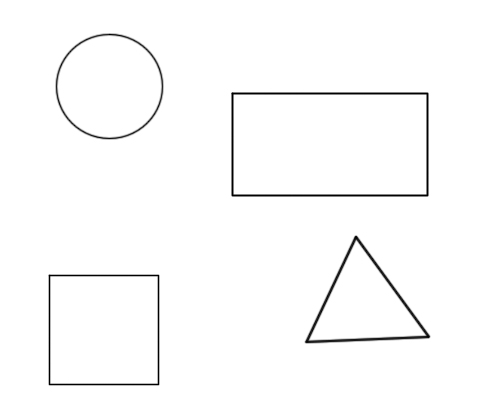
Now that I have given tips on how to use color effectively, let us discuss composition and layout. Composition and layout is the arrangement of artistic parts so as to form a unified whole. Hence, composition is the art of putting together all the elements of a piece to make a pleasing whole. Let's take for example a square, a rectangle a circle and a triangle in one art piece. If we just toss these objects to a given space without much thought, it would probably look like this:

Fig. 1 Posted by Picasa


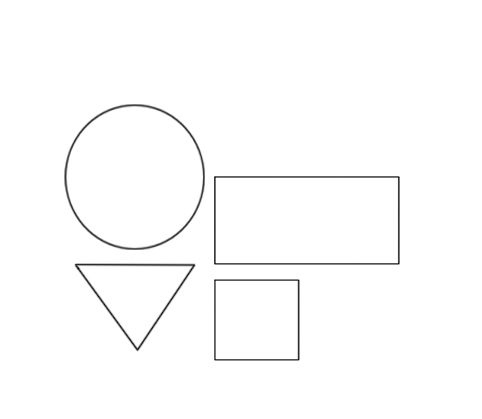
As you can see, they are unrelated and there is no movement at all. However, if we make a few adjustments, put them together in an artistic manner, then we have a more coherent arrangement. Something that goes like this:

Fig. 2 Posted by Picasa


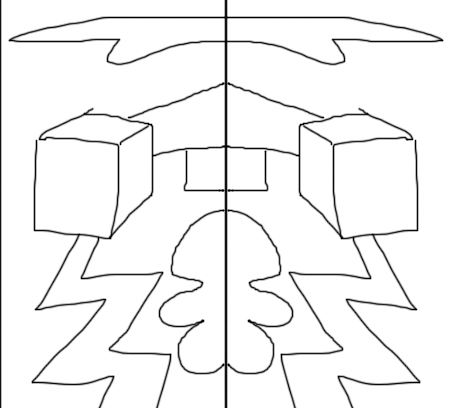
Remember, when doing a bulletin board, a poster or anything that calls for a visual presentation, always consider how you are going to put the various parts together. To do this, we must bear in mind the concept of balance. There are two types of balance in art. The first one is called Formal balance. This is when all the elements found at one side of the given space is also found at the other.

Fig. 3 Formal Balance Posted by Picasa


This type of balance is very safe for there is already symmetry. However, sometimes, this can be boring to look at. This brings us to the next type of balance which is called Informal balance

How is this done? Just like when two people of different weights ride a see saw, either the heavier one or the lighter person adjusts so that the seesaw will have a good equilibrium and they can enjoy the ride. This is what a good artist does. Find a "feel" for balance. There are some rules which we can follow. I can give you one. Remember, a big white object will balance several dark smaller objects. Hence:

Fig. 4 Informal Balance Posted by Picasa


If you see a photograph where all the elements are placed on the right side, don't you feel like they are falling off from the frame? That is because it has poor balance.

Lastly, consider patterns when making a design. you can use three basic patterns. These are, repetition, (aaaaaaaa), alternation (ababababab) and alteration.

Fig. 5 Pattern Posted by Picasa


Since my son (feel free to browse through his works) is already sleepy and it being a school day, I had to free him from helping me. Thus, using the same example, imagine that all the shapes are in white, that is repetition. Since I asked him to make it black and white, the pattern is alternation. If say on the space at the left of the picture, I created a red circle, then I would have altered the pattern, hence such will be alteration.

Lastly, one can use the rule of thirds. How this is done is by dividing the drawing or working space into three parts horizontally and vertically like so:

fig. 6 Rule of thirds  Posted by Picasa


The intersections are the most interesting spots where you can put your subject. Simple, right?

For a much more detailed lesson, you can go here and here

Saturday, August 13, 2005

Design 1

I will have to thank my son, Mickey, for patiently doing the images I present in this entry. As you see, it took him only a short while to do what I would have done in ages accompanied by almost bleeding to death, pouncing on my head and throwing the entire computer to the ground out of dismay.

One of the tasks given to teachers is the preparation of the classroom especially during the opening of classes. Not only that, they would be given assignments to display works of students, and occasionally design a bulletin board. What about those visual materials they have to prepare to aid the teaching of the lesson and hype it up a notch? All these require some knowledge in design, at least to a conscientious teacher, that is. Of course, one does not want to make sloppy work. Being an art teacher, I have been requested to do these things not only for myself but co-teachers as well. Since i am maintaining a blog and have not been inside a classroom for quite some time, I decided to share my little knowledge which I think would be most helpful to those facing the task of having to make a design for the school or even for just a class.

Allow me to start this off with color. Color is very important. When making a design, the important thing to remember is that it should be pleasing to the eye. Colors one must use should harmonize with one another. Often, you hear someone quip, "Somehow, the colors don't match!" When you hear this, you know that you failed to harmonize. There are people who have a knack for color. They have a good color sense. But what about those who don't? Don't despair for there are certain standards which we can follow so that we can never go wrong with our color choices.

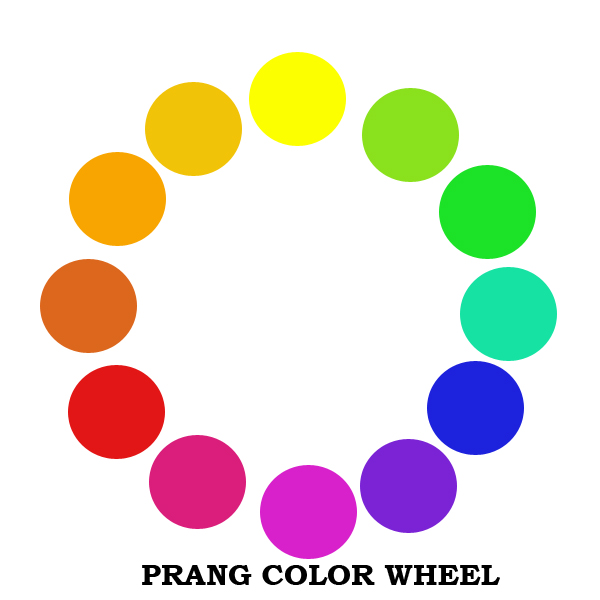
Hence, I introduce to you the Prang Color Wheel. This is a device designed by Mr. Prang to guide us with color combinations. This is how it looks like:

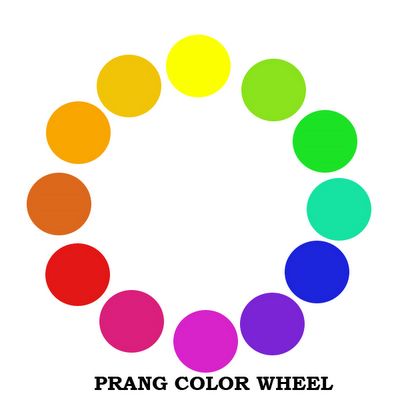
Posted by Picasa
Fig. 1


So, okay, now that you know that there is a color wheel, so what, you ask? The name of the colors as we know them, ex, red, violet, magenta, are called hues. Allow me to dissect this color wheel a bit. Let's start off with the very basic. We have three primary colors, viz., yellow, red and blue. These are called primary because these are the sources of all colors. We cannot produce these colors by mixing two or more colors. They are what they are. Let's present them in a triangle. Hence:
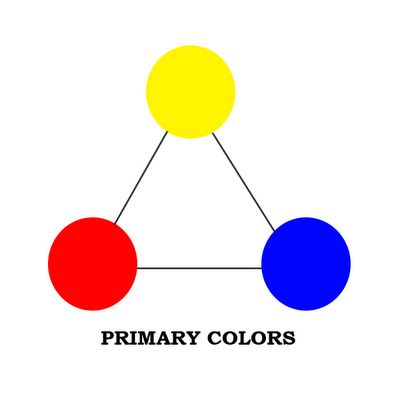
Posted by Picasa
Fig. 2


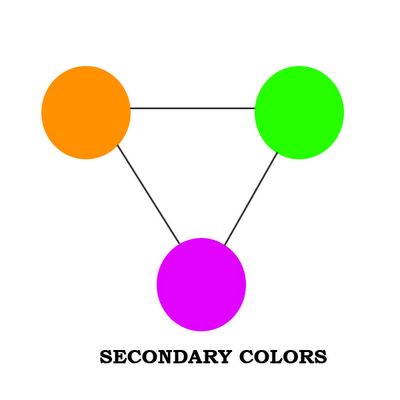
Now, what happens if we mix equal parts of two primary colors? Yes, we get secondary colors. These colors are orange (the mixture of red and yellow), violet (blue and red) and green (yellow and blue). Again, we can form a triangle to represent them.
Posted by Picasa
Fig. 3


Now, let's make it even more interesting. What about mixing one primary color with a secondary color? Of course, we get a tertiary color. Some people call them intermediate colors but just for the sake of simplicity, convenience and consistency, let's call it tertiary. Now, the wheel is complete. No, not really. We can still go in-between these colors but I'll let you do the imagining from this point on.


Posted by Picasa
Fig. 4


I can almost hear you saying, "So what? Fine, now I know there exists a cute arrangement of color. But what does it do?" Here comes the important part. There are various ways by which you can use this color wheel. From this, we derive proper color combinations artists call color harmonies. Again, I am going to present to you the very basic of these color harmonies.

First one is called MONOCHROMATIC color harmony. Mono means one, ergo, choose a color and by either adding white or black, lessen or increase the intensity of the color.

Here, I have made five different "shades" or "tones" of one color. So, if you have a drawing of say, a landscape, use these different tones to create a painting. Divide a drawing into several parts. Assign a number to each of the tone. Set aside. Put numbers on the segragated areas making sure no two area of the same number sits side by side. Apply the tone to the numbered area and there you go! YOu have made a monochromatic painting of a landscape.

Next one is called analogous harmony. Analogy means relationship. Thus, these are colors that are related to one another. Take a look at the color wheel again. Notice that colors to the left of yellow and violet viz., YO, O, RO, R, and RV come from one primary color which is red. On the right side, YG, G, BG, B and BV, the common color is blue. See the relationship? The colors to the left of yellow and violet are called "warm colors" while those to the right are called "cool". I shall let you decide which set would be suitable for what design. Just like the monochromatic harmony, what you can do to a drawing is segregate the areas into five to six numbers and assign each area a number. Apply the color and voila, you have a painting that uses analogous harmony. So, you ask, "what are yellow and violet? Cool or warm?" They are neutral colors!


Color Harmonies Posted by Picasa
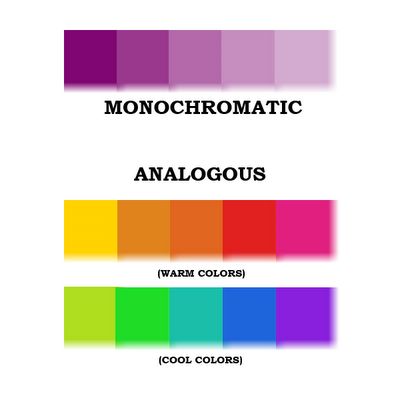
Fig. 5


Lastly, we have complementary colors. These are colors that lie opposite each other. They are called complementary because they somehow complete the color wheel. What do I mean? Remember how the colors are related to one another? Those in left being related because they all have a portion of red. However, they do not have any blue! So, in order to complete it, get the opposite color. Hence, orange and blue are complementary. So are red and green. Can you think of a season where the color harmony is predominantly red and green? In the example, I have made yellow and violet slightly bigger to show you how they lie opposite each other.

Posted by Picasa
Fig. 6


There are other ways by which you can use this wheel. For example, there is one called "split complementary" where you combine yellow with Red Violet and Blue Violet. As you make your works of art using this wheel, you will realize that tt's worth the trouble experimenting with color. i don't want to spoil your fun so this is where I get off and leave you to have your fun.